Trusted dentist in Mississauga for over 30 years.

Guided Biofilm Therapy vs. Traditional Dental Cleaning: Is GBT Worth It?

The short answer: Guided Biofilm Therapy (GBT) is a way of doing a professional cleaning. Plaque is coloured so it can be seen, then washed away with warm water, air and an ultra-fine powder. Scraping is kept only for hardened tartar. It cleans as well as a traditional scale and polish, and research on this type of air polishing finds most patients find it more comfortable. It doesn’t replace a deep cleaning when gum disease has gone below the gumline, but it’s often part of how that deeper care is done. If cleanings have ever been unpleasant for you, this could help you.


In this article

  1. What Guided Biofilm Therapy actually is
  2. GBT vs. other cleaning options, side by side
  3. Why patients like it
  4. Does it hurt? Is it safe? Is it worth it?
  5. Cost and insurance
  6. Quick FAQ


What Guided Biofilm Therapy Actually Is


Every cleaning has the same job: remove biofilm, the sticky layer of bacteria that builds up on teeth, gums, fillings, crowns and implants. Left alone, biofilm hardens into tartar and leads to cavities, gum inflammation and bad breath.


GBT is a step-by-step protocol developed by EMS, a Swiss dental company. It changes how biofilm is found and removed:


  • Find it first. A disclosing solution colours plaque, so your hygienist can see every spot, and so can you.
  • Wash it off. An Airflow® handpiece sprays warm water, air and a very fine erythritol-based powder that lifts biofilm and surface stains from teeth, gumlines and dental work.
  • Reach deeper pockets. A thin, flexible nozzle (Perioflow®) cleans gum pockets and the space around implants.
  • Scale only where needed. A slim ultrasonic tip (Piezon® PS) removes whatever hardened tartar remains, spot by spot rather than tooth by tooth.
  • Check the result. Your hygienist confirms the biofilm is gone before you leave.


You can see what a GBT visit looks like step by step on our GBT teeth cleaning Mississauga page.


GBT vs. Other Cleaning Options, Side by Side
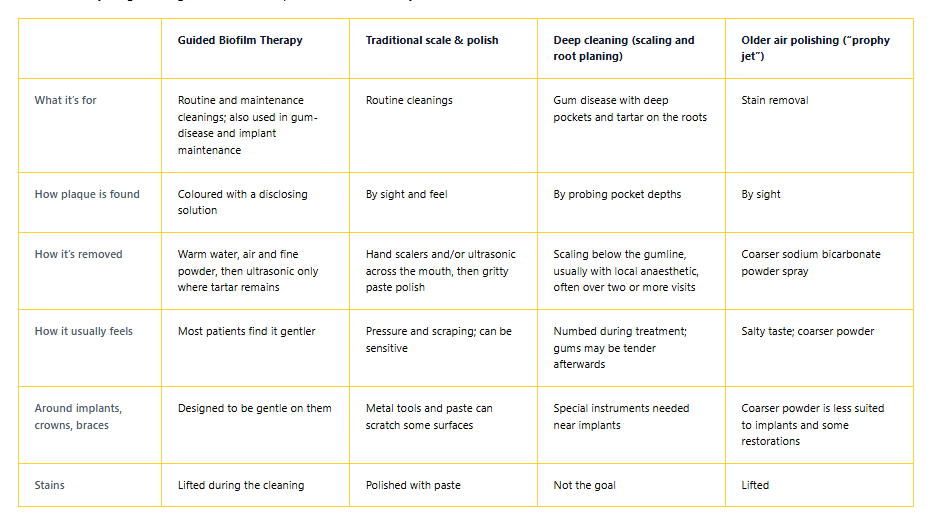
 

Patients usually weigh GBT against four other options. Here’s how they differ:

Dental Cleaning Treatments Comparison
Guided Biofilm Therapy Traditional scale & polish Deep cleaning (scaling and root planing) Older air polishing (“prophy jet”)
What it’s for Routine and maintenance cleanings; also used in gum-disease and implant maintenance Routine cleanings Gum disease with deep pockets and tartar on the roots Stain removal
How plaque is found Coloured with a disclosing solution By sight and feel By probing pocket depths By sight
How it’s removed Warm water, air and fine powder, then ultrasonic only where tartar remains Hand scalers and/or ultrasonic across the mouth, then gritty paste polish Scaling below the gumline, usually with local anaesthetic, often over two or more visits Coarser sodium bicarbonate powder spray
How it usually feels Most patients find it gentler Pressure and scraping; can be sensitive Numbed during treatment; gums may be tender afterwards Salty taste; coarser powder
Around implants, crowns, braces Designed to be gentle on them Metal tools and paste can scratch some surfaces Special instruments needed near implants Coarser powder is less suited to implants and some restorations
Stains Lifted during the cleaning Polished with paste Not the goal Lifted

GBT vs. a traditional scale and polish

Both aim for the same clean result. The difference is how you get there. A traditional cleaning scrapes and polishes the whole mouth. GBT finds plaque first, washes most of it away, and saves scraping for the spots that need it. Studies comparing erythritol air polishing with conventional instrumentation generally find similar plaque removal and gum improvement, with patients reporting less discomfort and often preferring air polishing when asked. It’s the approach we use for teeth cleaning Mississauga office.


GBT vs. deep cleaning (scaling and root planing)


This is the comparison people most often get wrong. A deep cleaning treats periodontitis: gum disease where pockets have formed and tartar has built up on the roots. GBT doesn’t make that treatment unnecessary. What it can do is make parts of it gentler and help maintain the results afterwards. If your gums bleed easily or you’ve been told you have deep pockets, your hygienist will measure them and recommend the right approach. Sometimes that’s a combination of both.


GBT vs. older air polishing


Air polishing isn’t new. Dentists have used sodium bicarbonate “prophy jets” for stain removal for decades. GBT differs in two ways. Its powder is much finer and sodium-free, and it’s used as part of a full protocol (disclose, remove, check) rather than as a quick stain polish at the end.

Why Patients Like It

Here’s what patients tend to notice most after a GBT cleaning:

Much less scraping.

Most plaque is washed away, so there’s far less instrument time on each tooth.

Easier on sensitive teeth.

The water is warmed, which is kinder to sensitive teeth than a cold spray.

No gritty paste.

There’s no polishing grit left between your teeth.

Seeing exactly where plaque builds up.

Coloured plaque makes brushing and flossing advice concrete, and many patients’ home care improves because of it.

A brighter look right away.

Coffee, tea and wine stains lift during the cleaning. (It isn’t whitening, but if you want a bigger change afterwards, SpaDent® whitening works best on freshly cleaned teeth.)

Easier with braces and implants.

The spray reaches around brackets, wires and implant crowns more easily than a polishing cup. It’s also a relief for people who have put off cleanings because of past discomfort. A gentler first visit makes it much easier to get back on a regular schedule.


It’s also a relief for people who have put off cleanings because of past discomfort. A gentler first visit makes it much easier to get back on a regular schedule.

Does Guided Biofilm Therapy hurt?


For most people, no. It’s the main reason patients ask for it. You’ll feel the spray and hear the handpiece, and very sensitive spots may still tingle. Tell your hygienist and they’ll adjust as they go. If hardened tartar needs removing, the slim ultrasonic tip is used only there.


Is it safe?


Yes. It’s used by dental practices around the world, and the powder is designed to be gentle on enamel, gums, fillings and implants. Let us know before your visit if you have asthma or another breathing condition, are pregnant, or have any medical conditions. Your hygienist can adapt the approach, as with any cleaning.


Is Guided Biofilm Therapy worth it?


If you’ve found cleanings uncomfortable, have sensitive teeth, wear braces or aligners, have implants or crowns, or want a more thorough look at where plaque builds up, most patients would say yes. If cleanings have always been easy for you, you’ll still get a thorough clean, with less scraping and a clearer picture of your home care. Not sure? Use our cleaning planner to see how a GBT visit can be tailored to you.


How long does it take, and how often should I have it?


A GBT cleaning fits into a regular hygiene appointment. Your first visit may take longer if there’s heavier tartar. Most people come every six months. Those with gum disease, implants, braces or heavy tartar often benefit from every three or four months. We’ll recommend an interval based on what we see.


Cost and Insurance


Dental plans cover professional cleanings by the procedures done, such as scaling and polishing, not by the technology used. So the question to ask is what your plan covers for a cleaning, not whether it covers GBT.


  • Private dental plans: we bill most plans directly, so you pay only the portion your plan doesn’t cover.
  • Canadian Dental Care Plan: preventive care, including cleanings, is covered under CDCP. The plan pays 100%, 60% or 40% of its set fees depending on your family income. We bill CDCP directly and tell you any out-of-pocket cost first.
  • No plan: we give you full fee disclosure before your appointment.
Try a GBT Cleaning in Mississauga

Caminschi Family Dentistry Mississauga on Dundas Street East offers Guided Biofilm Therapy for kids, adults and seniors. We have direct billing, accept CDCP, and are rated 4.9★ on Google. New patients get a free take-home whitening kit with a complete exam, X-rays and cleaning.

Quick FAQ

Airflow® is the air-polishing handpiece EMS makes. Guided Biofilm Therapy is the full protocol that uses it: disclosing, Airflow cleaning, deeper pocket cleaning if needed, ultrasonic scaling where tartar remains, and a final check. People often use the two names interchangeably.

It cleans as effectively as a traditional scale and polish, and most patients find it more comfortable. It’s especially helpful for sensitive teeth, braces, implants and anyone who finds cleanings stressful.

No. If you have periodontitis with deep pockets, you may still need scaling and root planing. GBT can be part of that care and helps maintain your gums afterwards.

Yes. The air-powder removes soft plaque and stains, and any hardened tartar is removed with a fine ultrasonic tip, just where it’s needed.

It removes surface stains, so teeth often look brighter, but it doesn’t change the natural colour of your teeth. For that, whitening is the next step.

Plans cover cleanings by the procedures performed, not the technology used. Most plans that cover cleanings will cover a GBT cleaning the same way. We bill most plans and CDCP directly and confirm your coverage before your visit.

Sources

  1. Martins et al. The efficacy of air polishing devices in supportive periodontal therapy: clinical, microbiological and patient-centred outcomes. A systematic review. International Journal of Dental Hygiene, 2023. PubMed
  2. Bühler et al. A systematic review on the patient perception of periodontal treatment using air polishing devices. International Journal of Dental Hygiene, 2016. Wiley
  3. Novel Approach to Dental Biofilm Management through Guided Biofilm Therapy (GBT): A Review. Microorganisms, 2021. MDPI
  4. Government of Canada. Canadian Dental Care Plan: what’s covered. Canada.ca

Airflow®, Perioflow® and Piezon® are registered trademarks of EMS Electro Medical Systems S.A. This article is general information, not a diagnosis. Talk to your dentist or hygienist about what’s right for you.


Enter your information below.

By submitting this form, you agree to receive communications from our practice. You may unsubscribe at any time.

This will close in 0 seconds


Enter your information below.

By submitting this form, you agree to receive communications from our practice. You may unsubscribe at any time.

This will close in 0 seconds


Enter your information below.

By submitting this form, you agree to receive communications from our practice. You may unsubscribe at any time.

This will close in 0 seconds